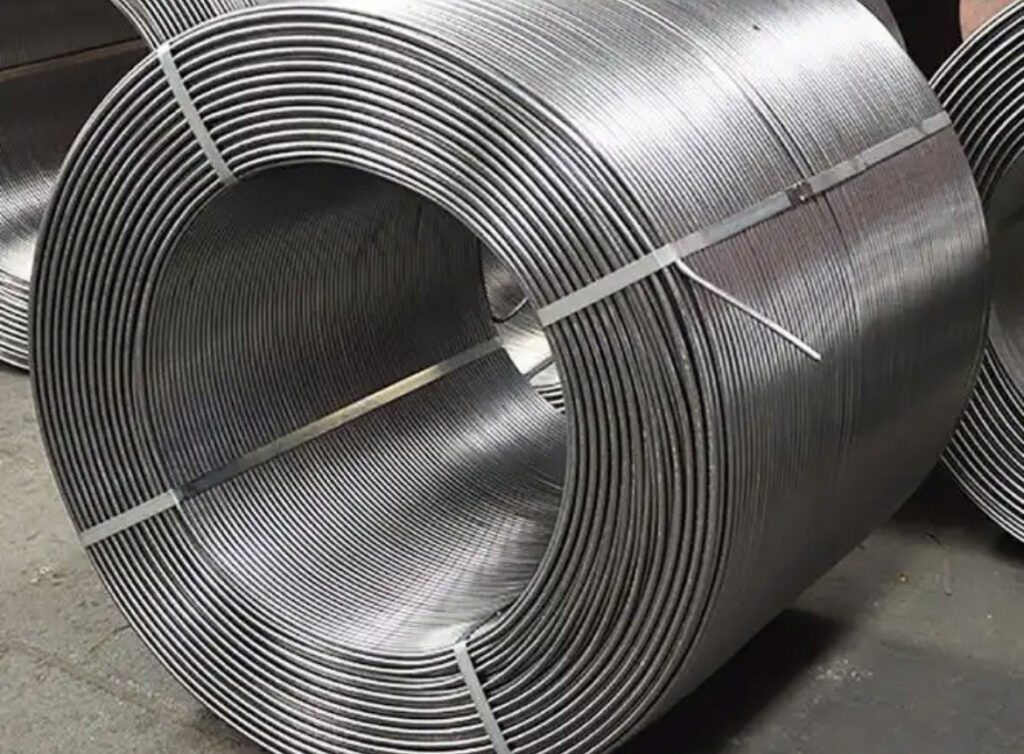
Calcium iron cored wire is not a single product with a single specification. The calcium content can range from 30% to 70%, with iron powder making up the balance. That ratio is not arbitrary. It determines how fast the calcium releases, how deep the wire penetrates and how much you pay per meter.
Many mills order the same ratio they have always used, often because it was the first product they tried or because it was the cheapest per meter. Neither reason is a good basis for a purchasing decision. The right ratio depends on your steel grades, your ladle depth and your feeding equipment. For background on the chemistry of calcium treatment in steel, you can refer to technical resources from industry knowledge platforms like ISPAT Guru.
For a general overview of when CaFe wire is the right choice at all, see our article on calcium iron cored wire when to choose it and when not to. This article focuses specifically on the ratio question, which is the decision you face once you have decided to use CaFe cored wire.
What the Ratio Actually Controls
The calcium to iron ratio affects three things: density, reactivity and cost.
Iron powder is roughly four times denser than calcium metal. Increasing the iron content makes the wire heavier per meter, which helps it sink faster and deeper into the ladle. That is an advantage for deep ladles or for practices where the wire has to penetrate a thick slag layer.
The iron also acts as a diluent. A higher iron content means a lower calcium concentration, which slows down the reaction. Pure calcium vaporises violently when it hits molten steel. Diluting it with iron moderates that reaction, giving the calcium more time to dissolve and react with sulfur and oxygen.
On the cost side, iron powder is significantly cheaper than calcium metal. A higher iron ratio lowers the cost per meter. But because the wire contains less calcium, you may need to feed more meters to achieve the same calcium addition. The cost per effective calcium is what matters, not the cost per meter.
Common Ratios and What They Mean
In practice, most CaFe wire falls into one of four ratios. Each has a distinct behaviour profile.
The mildest option offers a slow and gentle reaction with very little spattering, which makes it suitable for shallow ladles, small heat sizes and steel grades that need only light calcium treatment. That option is the 30/70 ratio, with 30% calcium and 70% iron. Cost per meter is the lowest of the four, but the calcium content is also the lowest.
A 40/60 ratio offers a stronger reaction than 30/70 while still being easy to control. Many mills use it as a general-purpose grade for carbon steels and structural grades where inclusion requirements are moderate.
The balanced behaviour of 50/50 makes it the most widely used ratio for aluminium-killed steels and general ladle treatment, with a reaction that is noticeable but not violent and recovery that is often good because the wire penetrates well without releasing everything at once.
If you need the strongest of the common grades, the one to consider is a 70/30 ratio. It behaves closer to pure calcium wire, with a faster and more energetic reaction. It is used for grades that need a higher calcium addition or for deep ladles where the extra density helps penetration. The cost per meter is higher, but the calcium content is also higher.
Matching the Ratio to Your Steel Grade
The steel grade is the first filter for ratio selection.
Ordinary carbon steels and rebar grades rarely need more than a 30/70 or 40/60 ratio. The inclusion requirements are moderate and the lower cost per meter makes these ratios attractive. There is no benefit to using a stronger ratio if the steel specification does not demand it.
When it comes to aluminium-killed steels and drawing-quality grades, the 50/50 ratio is usually the best starting point. These steels need reliable inclusion modification to prevent nozzle clogging and the balanced reaction of 50/50 gives good recovery without excessive spattering.
For HSLA and pipeline steels, a 50/50 or 70/30 ratio is often appropriate, depending on the sulfur level and the ladle depth. If the ladle is deep and the slag is thick, the extra density of 70/30 helps the wire reach the reaction zone.
Bearing steels and other critical grades may require the stronger 70/30 ratio or a switch to pure calcium wire if the calcium requirement is very high. CaFe wire has limits and for the most demanding applications, pure calcium is still the better tool.
Ladle Depth and Slag Thickness
The physical conditions in the ladle matter as much as the steel grade.
When the steel depth is only 2 to 2.5 meters, the extra density of a high-iron ratio is not needed. A 30/70 or 40/60 wire will penetrate adequately and the gentler reaction reduces spattering. Using a 70/30 wire in a shallow ladle is wasteful because the calcium releases before the wire reaches the bottom.
In a deep ladle, 3 meters or more, the picture changes. The wire has farther to travel before it reaches the reaction zone. A higher iron ratio helps it sink faster and resist premature melting. Under these conditions, 50/50 or 70/30 is often the better choice.
Beyond ladle depth, slag thickness plays a role as well. A thick, viscous slag can trap the wire before it reaches the steel. The denser wire from a higher iron ratio penetrates more reliably. If your slag is consistently thick, consider a 50/50 or 70/30 ratio even for ordinary steel grades.
Feeding Equipment Constraints
Your wire feeder has limits. A very stiff wire, which usually means a high iron ratio and a thick sheath, may not feed smoothly through a feeder with small rolls or tight bends. A softer wire feeds more easily but may break under tension.
If your feeder is older or underpowered, a 30/70 or 40/60 ratio is usually easier to handle. The wire is softer and more flexible. If your feeder is modern and well maintained, a 50/50 or 70/30 wire should feed without problems, provided the guide system is properly aligned.
The diameter of the wire also interacts with the ratio. A larger diameter wire with a high iron ratio is stiffer than a smaller diameter wire with the same ratio. If you need the density of a high-iron wire but your feeder struggles, consider reducing the diameter slightly.
How to Test a New Ratio
The best way to evaluate a new ratio is a trial. Order one coil of the candidate ratio and run it on a set of heats where you have good historical data with your current wire.
Compare the calcium recovery, the spattering behaviour, the feeding smoothness and the nozzle condition. If the new ratio improves recovery without causing feeding problems, it may be worth switching. If the results are similar, the cost per effective calcium becomes the deciding factor.
Do not change more than one variable at a time. If you switch from 40/60 to 50/50, keep the diameter, the feeding speed and the addition length the same for the trial. Otherwise you will not know which change made the difference.
Summary
The calcium to iron ratio in CaFe cored wire is a specification choice that affects reaction speed, penetration, recovery and cost. It is not a detail to be left to habit or to the cheapest option per meter. The right ratio depends on your steel grades, your ladle depth, your slag conditions and your feeding equipment.
Start with the steel grade. Match the ratio to the inclusion requirements and the ladle conditions. Run a trial if you are uncertain. And evaluate cost on the basis of effective calcium delivered, not price per meter.
If you need help selecting the right ratio for your operation, contact us. We supply CaFe cored wire in a range of ratios and can provide trial coils for evaluation.
If you have any needs, please contact us without any hesitation!