Abstract: While less common than cored wire, pure calcium solid wire serves as a specialized tool in secondary steelmaking. This article details its unique characteristics, updated application data, and niche roles in the production of ultra-low sulfur steels, certain stainless grades, and precision alloying.
1. Definition and Distinctive Characteristics
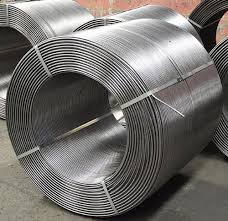
Calcium solid wire (or calcium metal wire) is drawn directly from high-purity calcium metal (typically >98.5% Ca), often with a thin metallic coating (e.g., nickel or steel) to enhance handling and storage stability. Unlike cored wire, it contains no silicon or significant iron from a powder core, offering a highly direct and “clean” source of calcium.
Its key distinguishing feature is its extremely rapid reaction kinetics. Upon entering the molten steel, the thin coating melts almost instantly, exposing pure calcium to the melt. This leads to immediate, intense local reaction and vaporization.
2. Metallurgical Actions and Updated Performance Data
The primary metallurgical functions are similar to CaFeSi wire but with notable differences in mechanism and outcome:
Deep Desulfurization: The rapid release of pure calcium creates a localized, highly reducing environment. This makes it exceptionally effective for achieving ultra-low sulfur levels (<0.0010% or 10 ppm), particularly as a final “polishing” treatment after conventional desulfurization. Data shows it can achieve a final desulfurization efficiency of 30-50% in this polishing stage, albeit with lower overall calcium yield.
Inclusion Modification: The mechanism is more aggressive. The violent reaction promotes intense stirring, which can be beneficial for breaking up alumina clusters. However, control is more challenging. The effective calcium yield for inclusion modification is generally lower and more variable (5-15%) compared to cored wire due to significant vapor loss.
Trace Element Control: The absence of silicon in the addition agent is its decisive advantage. It is indispensable for treating silicon-sensitive grades, such as:
Electrical Steels: Where silicon content must be precisely controlled for magnetic properties.
Certain Austenitic Stainless Steels: Where silicon can negatively affect high-temperature oxidation resistance and phase stability.
Other Specialty Alloys: Where introducing silicon from CaSi is detrimental to final composition.
3. Process Challenges and Handling Innovations
The use of solid calcium wire presents specific operational hurdles:
Low and Unpredictable Yield: The high vaporization loss necessitates careful process control. Recent improvements involve synchronized, soft argon stirring and precise control of the wire immersion point and depth to maximize yield.
Safety and Handling: Pure calcium is pyrophoric and corrodes in humid air. Modern supply chains now provide wire in vacuum-sealed packs or under inert gas in drums. New coating technologies (e.g., a dual-layer Ni/Zn coating) have extended safe shelf life to 6-9 months under proper storage.
Feeding Technology: Requires sturdy, calibrated feeders capable of handling the softer wire without buckling, typically at lower feed speeds (1.5-3 m/s) than cored wire.
4. Contemporary Application Niches and Economic Considerations
The application of calcium solid wire is highly targeted:
Niche 1: Ultra-Low Sulfur Steel Finishing. Used in a small dosage (e.g., 0.1-0.2 kg Ca/ton) as the final step to reach sulfur specs below 10 ppm for critical forgings and offshore plate.
Niche 2: Silicon-Free Calcium Treatment. The only viable option for the grades mentioned above. Dosage is calculated strictly based on the stoichiometric requirement for inclusion modification, often resulting in lower total consumption per ton but at a higher unit material cost.
Niche 3: Pocket Treatment in Tundish. For small-scale, corrective treatment in the tundish to improve castability, though this practice is declining with better ladle metallurgy control.
Economic Balance: While the raw material cost per kg of Ca is higher than in CaSi, its use is justified by the value of the final product and the absence of silicon contamination. Its total consumption is typically an order of magnitude lower than that of CaFeSi wire in a standard steel plant.
5. Conclusion
Calcium solid wire is not a substitute for calcium ferrosilicon cored wire but a specialized precision tool. Its value lies in its unique ability to deliver pure calcium without introducing silicon, making it essential for specific high-value, silicon-sensitive steel grades, and for achieving the most stringent ultra-low sulfur targets. Its application demands rigorous process control and handling protocols but remains irreplaceable within its defined metallurgical niches in advanced specialty steelmaking.