In the fiercely competitive metals industry, the pursuit of profitability often focuses on large-scale efficiencies and raw material prices. However, some of the most significant gains are hidden in plain sight, within the very process of alloying itself. The shift from traditional bulk alloy addition to the use of cored wire technology represents a fundamental change, unlocking what can be termed “invisible profits” by dramatically improving yield and process control.
While the upfront cost of cored wire can be higher than that of bulk alloys, a deeper cost analysis reveals a compelling narrative of savings. The key lies not in the price per kilogram of the additive, but in the “yield”—the percentage of the alloy that is effectively absorbed into the melt.
The Problem with Traditional Methods: Visible Waste, Hidden Costs
When adding alloys in bulk form (lumps, briquettes, or bars), several inefficiencies are inherent:
1. Oxidation Losses: A significant portion of reactive elements like Calcium, Magnesium, and rare earths oxidizes upon contact with air or slag before they can dissolve into the molten metal. This is literally money burning away as fume.
2. Slag Entrapment: Lightweight alloys float on the slag layer and are lost, requiring larger additions to achieve the desired chemistry.
3. Low and Unpredictable Yield: The yield for bulk additions of highly reactive elements can be as low as 10-30%. This unpredictability forces operators to “over-add” to meet specifications, leading to costly and inconsistent results.
The Cored Wire Solution: Precision Delivery for Maximum Yield
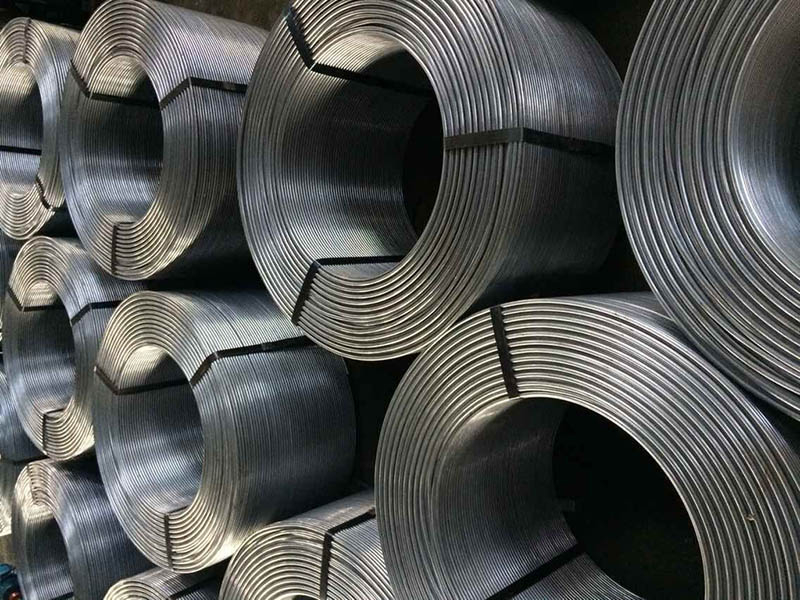
Cored wire is a simple yet revolutionary solution: a metallic sheath (usually steel) filled with a precise dosage of powdered alloys or reagents. It is fed directly into the molten bath using a wire feeder.
This method directly addresses the shortcomings of bulk addition:
·Deep Injection: The wire penetrates deep below the slag and metal surface, delivering the alloy directly into the melt where reaction is desired.
·Minimized Oxidation: The steel sheath protects the core from oxidation during descent.
·Controlled Reaction: The release is gradual and localized, preventing violent reactions and improving homogeneity.
The result is a dramatic increase in yield. Recovery rates for elements like Calcium can jump from 15% with bulk addition to “70-90% or higher” with cored wire.
Calculating the Invisible Profit: A Practical Example
Let’s quantify these savings with a simplified calculation for adding Calcium to steel.
·Scenario: Adding 50 kg of Calcium to a 50-tonne ladle.
1. Using Bulk Calcium (Assumed Yield: 20%)
·Required Absorption: 50 kg
·Actual Addition Needed: 50 kg / 0.20 yield = 250 kg of Calcium
· Cost (assuming $5/kg for bulk Calcium): 250 kg * $5/kg = $1,250
2. Using Calcium Cored Wire (Assumed Yield: 80%)
· Required Absorption: 50 kg
·Actual Addition Needed: 50 kg / 0.80 yield = 62.5 kg of Calcium
·Cost of Calcium in wire (assuming $7/kg, accounting for wire production): 62.5 kg * $7/kg = $437.50
·Direct Alloy Cost Savings:
$1,250 (Bulk) – $437.50 (Cored Wire) = $812.50 per ladle.
This is a direct saving of “65% on the alloy cost” for this single element. When scaled to hundreds of heats per month, the “invisible profit” becomes a substantial, visible line item on the balance sheet.
Beyond Alloy Cost: The Ripple Effect of Savings
The financial benefits of cored wire extend far beyond the direct cost of the alloy:
·Improved Cleanliness and Quality: Better inclusion morphology control leads to superior product quality, fewer rejects, and the ability to command premium prices.
·Reduced Desulfurization Costs: Higher calcium yield means less wire is needed for effective sulfide shape control.
·Longer Refractory Life: The controlled reaction is less erosive to ladle linings than the violent reaction of bulk additions.
·Reduced Fume and Environmental Costs: Less oxidation means lower emissions, potentially reducing costs associated with environmental compliance.
Conclusion: Making the Invisible, Visible
The initial price tag of cored wire can be deceptive. A true measure of cost must be “Cost per Unit of Effective Alloy in the Melt.” By focusing on yield, it becomes clear that cored wire is not an expense but a high-return investment.
The “invisible profits” are realized through drastically reduced material usage, improved process consistency, and enhanced final product quality. For any operation serious about optimizing its bottom line, a detailed analysis of cored wire implementation is not just recommended—it is essential. It’s time to calculate your own savings and turn hidden inefficiencies into a powerful competitive advantage.