In the intricate and demanding world of secondary steelmaking, the ability to precisely control the composition and morphology of molten steel is paramount to achieving high-quality final products. Among the various technologies developed for this purpose, the injection of cored wire stands out as a highly effective method. Specifically, “Pure Calcium Cored Wire” has become an indispensable tool for metallurgists, offering a reliable and efficient means of modifying non-metallic inclusions, controlling castability, and enhancing the mechanical properties of steel.
What is Pure Calcium Cored Wire?
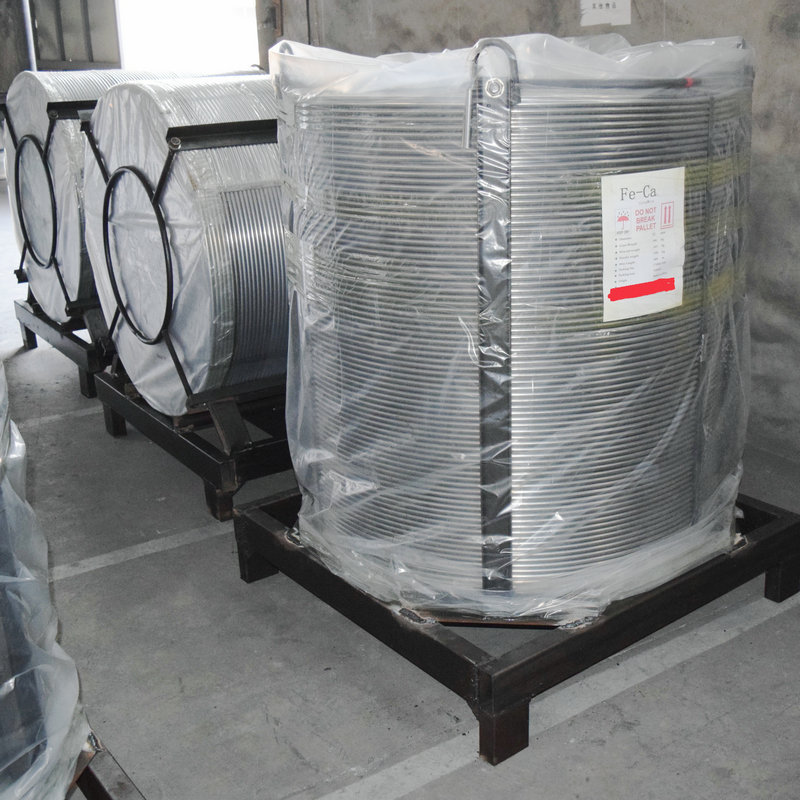
As the name suggests, pure calcium cored wire is a composite product designed to introduce calcium metal deep into liquid steel. It consists of two primary components: a metallic sheath (typically made of low-carbon steel, iron, or even stainless steel) and a core filling of finely divided, pure calcium metal or calcium alloy powder. The sheath acts as a protective carrier, allowing the wire to be fed rapidly through the ladle slag and into the molten bath before the calcium melts and vaporizes.
Why Use Calcium? The Metallurgical Imperative
Calcium is a powerful reactive element in steelmaking. Its primary functions are:
1. Inclusion Modification: This is the most critical function. During the deoxidation process, aluminum is commonly used, resulting in the formation of solid, stringer-like alumina (Al₂O₃) inclusions. These hard, non-deformable inclusions are detrimental to the mechanical properties of the final product, causing fatigue cracks, reducing toughness, and impairing surface quality. When calcium is introduced into the steel, it reacts with these alumina inclusions. The reaction transforms them into liquid calcium aluminates (e.g., CaO-Al₂O₃) at steelmaking temperatures. These liquid, spherical inclusions are much less harmful. They do not cluster together and are less likely to clog the nozzle during continuous casting, a phenomenon known as “clogging.” This transformation from solid alumina to liquid calcium aluminate is the cornerstone of calcium treatment.
2. Desulfurization: Calcium also has a high affinity for sulfur. It can form calcium sulfide (CaS). In certain steel grades, this helps to achieve extremely low sulfur levels, which is beneficial for improving ductility and resistance to hydrogen-induced cracking (HIC). However, this must be carefully controlled, as excessive formation of solid CaS inclusions can itself become a problem.
3. Castability Improvement: By modifying inclusions and controlling their morphology, the fluidity of the molten steel is significantly improved. This ensures a smooth, continuous casting process, free from interruptions caused by nozzle clogging. This directly translates to higher productivity and lower production costs.
The “Wire” Advantage: How It Works
Injecting pure calcium directly into steel presents a significant challenge. Calcium has a very low density (approximately 1.55 g/cm³) and an extremely low boiling point (1484°C), which is well below the temperature of molten steel (around 1600°C). If calcium lumps were simply added to the ladle, they would instantly float to the surface and vaporize, resulting in extremely low and inconsistent yields.
Pure calcium cored wire solves this problem ingeniously. The wire is fed by a high-speed injection machine deep into the steel bath. The steel sheath momentarily protects the calcium core. As the wire descends, the outer sheath melts. By the time the calcium core is exposed, it is already deep within the steel, surrounded by intense ferrostatic pressure. This pressure suppresses the violent vaporization, allowing the calcium to dissolve and react with the molten steel and inclusions. This method ensures a high, predictable, and consistent recovery rate of calcium, typically ranging from 10% to 30%, depending on the specific steel grade and treatment conditions.
Advantages of Pure Calcium Cored Wire
The use of cored wire technology offers several distinct advantages over other alloy addition methods:
– Precision and Control:The amount of calcium added can be precisely controlled by adjusting the length and feed rate of the wire. This allows for accurate targeting of the desired inclusion chemistry.
– High and Consistent Yield:As explained, the deep injection technique ensures that the calcium is utilized effectively, maximizing its metallurgical effect and minimizing waste.
– Safety: Handling and adding pure calcium in bulk can be hazardous. The cored wire encapsulates the reactive metal, making the addition process far safer for operators.
– Operational Efficiency:The injection process is rapid and can be fully automated, fitting seamlessly into the modern steel plant’s production rhythm.
– Improved Steel Quality: The ultimate benefit is the production of cleaner steel with superior and more isotropic mechanical properties, enhanced fatigue life, and better surface quality.
Applications and Modern Steel Production
Pure calcium cored wire is a standard treatment for a wide range of steel grades, including:
– Line pipe steels requiring resistance to sour gas (HIC).
– High-strength low-alloy (HSLA) steels used in automotive and construction.
– Spring steels and bearing steels demanding high fatigue resistance.
– Engineering steels for critical components.
In conclusion, pure calcium cored wire is far more than just a delivery system. It is a sophisticated metallurgical tool that enables steelmakers to exert fine control over the internal cleanliness and properties of their product. By transforming harmful inclusions and ensuring smooth castability, this relatively simple technology plays an outsized role in the production of the high-performance steels that underpin modern industry. Its continued use and development remain central to the pursuit of ever-higher quality and performance standards in steel manufacturing.