In the fiercely competitive global steel industry, leading mills are constantly seeking an edge—not just in product quality, but also in operational efficiency and cost-effectiveness. One seemingly small but profoundly impactful innovation that has become a standard in these top-tier facilities is the use of Calcium-Iarth Wire (or Cored Wire). While the technical benefits of calcium treatment for molten steel are well-known, the decision to adopt this specific method is fundamentally driven by powerful economic logic.
This article delves into the reasons behind this preference, revealing the significant economic advantages that make calcium-irarth wire the choice for champions.
The Core Problem: Taming Sulfur and Oxygen
To understand the value of calcium-irarth wire, we must first understand the enemy: sulfur (S) and oxygen (O) in molten steel.
“Sulfur”“causes ”“hot shortness”, making steel brittle and prone to cracking during rolling and forging.
“Oxygen” leads to the formation of non-metallic inclusions (like alumina, Al₂O₃), which severely degrade steel’s ductility, toughness, and fatigue strength.
For high-grade steel used in automotive, aerospace, and machinery, these impurities are unacceptable. The challenge is how to remove them efficiently and consistently.
The Solution: Calcium Treatment via Cored Wire
Calcium (Ca) is a powerful deoxidizer and desulfurizer. When added to molten steel, it reacts to form calcium aluminate inclusions, which are globular, liquid, and less harmful than solid alumina clusters. This process is known as “inclusion morphology control.”
The traditional method of adding calcium—through bulk alloys or plunging—is inefficient and unpredictable. Calcium has a very low boiling point and high vapor pressure, causing it to vaporize violently upon contact with the hot steel, leading to poor and inconsistent yield.
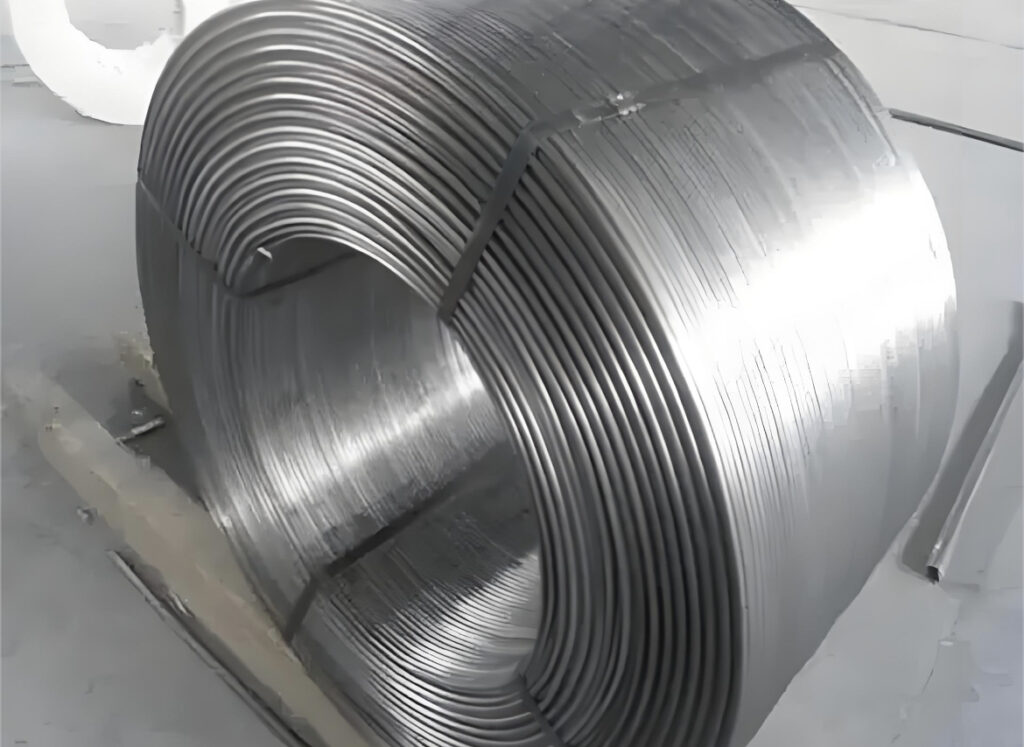
This is where calcium-irarth wire shines. It consists of a thin steel sheath tightly packed with a precise mixture of calcium and iron powder. This wire is fed directly into the molten steel ladle at a controlled speed and depth using a specialized wire feeder.
The Economic Benefits: A Breakdown for the Bottom Line
The shift to calcium-irarth wire is not just a technical upgrade; it’s a strategic financial decision. Here’s how it translates into tangible economic gains:
1. Drastically Improved Calcium Yield
This is the single most important economic factor. By injecting the wire deep into the ladle, the external pressure of the molten steel suppresses the vaporization of calcium. This ensures that a much higher percentage of the expensive calcium (typically 85-95% yield) actually reacts with the steel, compared to a meager 10-20% with traditional methods. Top mills see this as a direct reduction in raw material cost per ton of steel produced.
2. Unmatched Process Control and Consistency
The automated wire-feeding process allows for precise control over the amount of calcium added. This eliminates guesswork and ensures that every heat of steel meets the exact same stringent quality specifications. This consistency reduces the rate of off-spec or rejected batches, saving millions in potential scrap and rework costs.
3. Enhanced Steel Quality and Product Value
Steel treated with calcium-irarth wire exhibits:
·Improved Castability: Prevents nozzle clogging in continuous casters, leading to fewer operational interruptions and longer equipment life.
·Superior Mechanical Properties: Better toughness, ductility, and fatigue resistance allow mills to command a premium price for their high-performance steel products.
·Enhanced Machinability:The modified inclusions make the steel easier to machine for end-users, a key selling point.
4. Operational Efficiency and Cost Savings
·Reduced Processing Time: The wire-feeding process is fast and integrated into the secondary metallurgy stage, minimizing tap-to-tap time and increasing overall throughput.
·Lower Labor Costs:The process is highly automated, requiring less manual intervention compared to older, more labor-intensive methods.
·Decreased Refractory Wear:The controlled reaction is less aggressive on the ladle lining than violent plunging operations, reducing maintenance downtime and refractory costs.
5. Environmental and Safety Advantages
Using sealed cored wire minimizes the exposure of calcium to air, reducing fuming and oxidation losses. This creates a safer working environment with less pollution and aligns with the stringent environmental, health, and safety (EHS) standards that top-tier mills must uphold, avoiding potential fines and reputational damage.
Conclusion: An Investment, Not an Expense
For world-class steel producers, the choice of calcium-irarth wire is a clear-cut case of smart economics. The initial investment in wire-feeding equipment is quickly offset by the cascade of benefits:
·Higher yield of an expensive alloy.
·Superior and consistent product quality.
·Increased operational efficiency.
·Reduced scrap and downtime.
In essence, calcium-irarth wire transforms the critical process of inclusion control from an unpredictable art into a precise, cost-effective science. It is a key enabler that allows top steel mills to produce superior grades of steel reliably and profitably, securing their position at the pinnacle of a demanding industry. The wire is thin, but the economic impact is substantial.