Introduction
Calcium iron cored wire sits in an awkward spot in the product lineup. It is not as powerful as pure calcium wire. It does not add silicon like calcium silicon wire. But it is cheaper than both. For many steelmakers, that trade off is exactly what they need. For others, it is a false economy.
At JINLI GROUP, we supply calcium iron cored wire to mills that have figured out where it fits in their practice. We also talk to mills that tried it and were disappointed, usually because they used it in the wrong application or expected it to do something it cannot.
This article helps you decide whether calcium iron cored wire belongs in your operation. We will look at where it works well, where it does not and what to check when you receive a shipment.
What Calcium Iron Cored Wire Actually Is
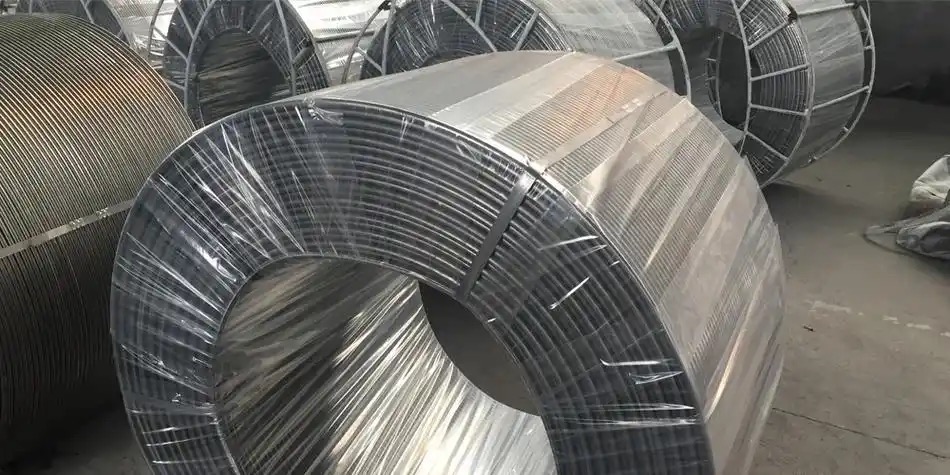
Calcium iron cored wire, often written as CaFe cored wire, has a core made of a mixture of calcium metal and iron powder. The calcium content typically ranges from 30% to 70%, with iron making up the balance. The outer sheath is a steel strip, folded and sealed.
The iron in the core serves two purposes. Firstly, it increases the density of the wire, helping it sink deeper into the ladle. Secondly, it dilutes the calcium, moderating the violent vaporisation that pure calcium wire is known for. The result is a calmer reaction. And in many cases, better calcium recovery than pure wire, even though the wire contains less calcium per meter.
That is the theory and it works in practice for many mills. But the key word is “many,” not “all.”
Where Calcium Iron Cored Wire Works Well
Let us start with the applications where CaFe cored wire is a good choice.
Ordinary carbon steels are the most common application. These grades do not need the full power of pure calcium. They just need enough calcium to modify inclusions and prevent nozzle clogging. CaFe cored wire delivers that at a lower cost.
Construction steels, rebar and structural sections fall into the same category. The inclusion requirements are not tight and the cost saving from using CaFe cored wire adds up over a campaign.
Mills with consistent slag practice also benefit from CaFe cored wire. Because the reaction is calmer, the wire is more forgiving of variations in slag thickness and steel temperature. If your practice is stable, you can dial in a CaFe addition and get repeatable results.
Shops that struggle with the violent reaction of pure calcium often find CaFe cored wire easier to handle. Less spattering means less smoke, less wear on the ladle cover and less stress on the operators.
Hybrid practices are another good fit. Some mills use a short length of pure calcium wire for a strong initial reaction, followed by CaFe cored wire for sustained modification. This combination gives the best of both worlds.
Where Calcium Iron Cored Wire Does Not Work Well
Now let us look at the other side. There are situations where CaFe cored wire is not the right tool.
Very low sulfur steels require every bit of calcium to react with sulfur. The diluted calcium in CaFe cored wire means you have to feed more wire to get the same effect. In some cases, the additional wire length becomes impractical. Pure calcium wire is usually better for these grades.
Critical inclusion control applications, such as bearing steels or automotive exposed panels, demand the strongest possible modification effect. CaFe cored wire may not deliver enough calcium to achieve the required inclusion population. Stick with pure calcium or calcium silicon wire for these grades.
Mills with short ladle treatment time may find that CaFe cored wire does not deliver calcium quickly enough. The slower reaction is an advantage in most cases, but if you have only a few minutes before casting, you need the faster calcium release of pure wire.
When storage conditions are poor, CaFe cored wire can degrade just like pure calcium wire. The calcium in the core reacts with moisture over time. If your warehouse is humid, you may not get the shelf life you expect.
The Cost Question
The main reason mills switch to CaFe cored wire is cost. Pure calcium wire is expensive. CaSi cored wire is also expensive because of the silicon content. CaFe cored wire is cheaper than both.
But the price per meter is not the whole story. You also need to consider the feeding length. Because CaFe cored wire contains less calcium per meter, you typically need to feed more meters to achieve the same calcium addition. The cost saving per meter may be offset by the increased consumption.
Let us run an example. Suppose pure calcium wire costs $0.60 per meter and contains 97% calcium. CaFe cored wire with 50% calcium costs $0.35 per meter. To deliver the same amount of calcium, you need roughly twice as much CaFe cored wire. The cost per effective calcium is actually similar. The advantage of CaFe cored wire comes from better recovery, not from lower calcium content.
If your CaFe recovery is 5% higher than pure calcium recovery, the cost advantage becomes real. If recovery is the same, the cost saving is negligible. That is why recovery data from your own shop is essential before making a switch.
How to Check CaFe Cored Wire Quality on Arrival
A few simple checks can tell you whether your CaFe cored wire is good or not.
First of all, look at the steel sheath. It should be smooth and uniform, with a clean weld seam. If the sheath has rust or pitting, moisture has penetrated. If the weld is rough or has gaps, the core may leak.
In addition, cut a one meter sample and weigh it. Compare the weight to the specification on the certificate. A variation of more than 3% suggests uneven core filling. That leads to inconsistent calcium addition from heat to heat.
Thirdly, inspect the core. The calcium and iron powder inside should be uniformly mixed. If you see layers or clumps, the filling process was not controlled. The calcium distribution will be uneven.
Last but not least, bend a short piece of wire 90 degrees. A good wire will bend smoothly with no cracking. A poor wire will crack or split open at the weld seam. That indicates weak welding or poor ductility.
At JINLI GROUP, we test every coil before shipping. We also provide a certificate with the actual analysis.
Storage and Handling
Calcium iron cored wire is less reactive than pure calcium wire, but it still needs care. The calcium content means it can absorb moisture if left in humid conditions.
Store coils on pallets, off the concrete floor and covered with plastic sheeting. Use older coils first. If a coil has been stored for more than three months, cut off the first few meters and inspect the core. If the calcium looks dark or crumbly, discard that section.
When to Try a Trial
The best way to know if CaFe cored wire works for you is to run a trial. Order one coil of CaFe cored wire and use it on a set of heats where you have good historical data.
Compare your calcium recovery, your nozzle life, your feeding downtime and your steel quality. If the improvements or cost savings justify the switch, scale up. If not, stick with what you were using.
A trial also helps you dial in the right feeding length. Because CaFe cored wire contains less calcium, you will need to adjust your feeding parameters. Do not simply substitute meter for meter. Work out the calcium content difference and start from there.
Conclusion
Calcium iron cored wire is a cost effective alternative to pure calcium wire for many steel grades. It gives calmer reaction, often better recovery and lower cost per meter. But it is not a universal solution. For very low sulfur steels and critical inclusion control applications, pure calcium or calcium silicon cored wire is still the better choice.
The key is to match the tool to the job. If you produce ordinary grades with moderate requirements, CaFe cored wire is worth a look. If you produce premium grades, you may need the extra power of pure calcium.
At JINLI GROUP, we supply CaFe wire in various ratios and specifications. We can help you set up a trial, compare results and decide whether it makes sense for your operation. Contact us to discuss your needs.
If you have any needs, please contact us without any hesitation!