Introduction
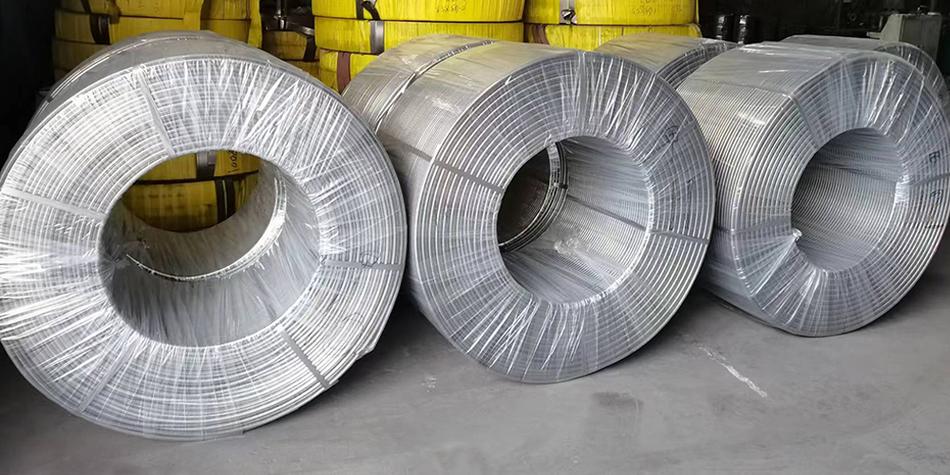
Calcium silicon cored wire is a reliable tool for inclusion modification and desulfurization. It gives better calcium recovery than pure wire in most practices and it adds silicon at the same time. Many steelmakers use it as their standard calcium carrier.
But there is a question that comes up repeatedly. How much should I add? The textbook answer is often vague and the right amount depends on your steel grade, your slag practice and your casting conditions. Add too little and the nozzles still clog. Add too much and you waste money and you can even degrade the steel.
At JINLI GROUP, we supply calcium silicon cored wire to steel mills that use it across a range of steel grades. This article focuses on the practical side of determining the right addition amount for different applications, recognising when you have added enough and what happens when you get it wrong.
The Right Amount Is Not a Fixed Number
There is no single addition rate that works for all steels. A 0.8 kg per ton addition might be perfect for one grade and completely inadequate for another. The variation comes from several factors.
To begin with, the inclusion population before calcium treatment is different for each steel. A steel with high oxygen activity or coarse alumina will consume more calcium. A clean steel with low oxygen needs less.
Secondly, the slag condition affects calcium consumption. An oxidizing slag will absorb calcium before it reaches the steel. A reducing, basic slag allows more calcium to do useful work.
Furthermore, the continuous casting practice matters. Long casting sequences need more reliable modification. Short sequences can tolerate more variation.
So instead of memorising a fixed number, you need a method to determine the right amount for each grade and each set of conditions.
A Practical Way to Find the Right Amount
The most reliable method is to adjust based on the calcium recovery and the nozzle condition.
Start with a conservative addition. For an aluminium killed steel with moderate inclusion control requirements, a good starting point is 1.0 kg per ton. For a steel with tight inclusion requirements, start at 1.5 kg per ton.
After the heat is cast, check two things: the total calcium recovery and the nozzle condition. If the nozzle is clean and the recovery is above 20%, you can try reducing the addition slightly. If the nozzle shows signs of clogging or the recovery is below 15%, you need to increase the addition.
Repeat this adjustment over several heats. You will find a range that works consistently for that grade. That range becomes your standard addition.
The key is to keep records. Write down the addition amount, the starting and ending calcium, the recovery and the nozzle condition for each heat. Over time, you will see patterns that help you fine tune.
Different Steel Grades, Different Needs
Let us look at how addition amounts vary across common steel grades.
Plain carbon steels and rebar grades have the lowest requirements. These steels do not need tight inclusion control. A calcium silicon addition of 0.5 to 0.8 kg per ton is often sufficient. The main purpose is to prevent nozzle clogging, not to achieve very low inclusion counts.
Aluminium killed drawing quality steels need more attention. The alumina inclusions from aluminium deoxidation can cause severe nozzle clogging. A typical addition is 1.0 to 1.5 kg per ton. The calcium modifies the alumina into liquid calcium aluminates, which do not clog nozzles.
Pipeline steels and high strength low alloy grades need even more. The inclusion requirements are stricter because inclusions affect toughness and hydrogen induced cracking resistance. Addition rates of 1.5 to 2.0 kg per ton are common.
Specialty grades like bearing steels or automotive exposed panels have the tightest requirements. These steels need very clean inclusion populations. Addition rates can go up to 2.5 kg per ton and multiple additions are sometimes used.
Remember that these are starting points. Your actual rates may differ based on your practice and your steel chemistry.
The Cost of Overfeeding
Adding too much calcium silicon cored wire is not just a waste of money. It can cause problems in the steel.
Excessive calcium can lead to the formation of calcium sulphide inclusions. These are hard and brittle. And they can affect the steel’s machinability and fatigue life. In some cases, they can even act as crack initiation sites.
Excessive calcium can also increase the total inclusion count. The calcium modifies alumina into calcium aluminates, which are liquid at steelmaking temperatures. That is good for nozzle clogging. But if you add too much calcium, the excess forms calcium sulphide inclusions that remain solid at steelmaking temperatures. Those solid inclusions are detrimental.
Silicon overfeeding is another concern. If your steel has a tight silicon specification, adding too much CaSi wire can push you out of spec. Every meter of CaSi wire adds a small amount of silicon. Over a long campaign, that can add up.
The Cost of Underfeeding
Underfeeding is a more obvious problem. The nozzles clog, the casting sequence is interrupted and you lose production time. A single clogged nozzle can cost more than an entire coil of wire.
Underfeeding also shows up in the final steel. Inclusions are not properly modified. The steel may have surface defects, poor formability or reduced toughness.
The balance between overfeeding and underfeeding is what you are trying to achieve. That is why adjustment based on nozzle condition is so important. The nozzles tell you whether you are feeding enough.
How to Know When You Have Added Enough
There are a few indicators that tell you the calcium addition is sufficient.
The nozzle condition is the most direct indicator. If the nozzle runs clean and the casting sequence is smooth, you are in the right range. If you see build up on the nozzle, you need more calcium.
The calcium recovery is another indicator. If recovery is stable and consistent, the addition is well matched to the practice. If recovery is highly variable, the addition amount is not the only issue, but it is worth checking.
The inclusion rating from the lab is a lagging indicator. It tells you whether the previous heats were properly treated. If the inclusion rating is consistently good, your addition amount is adequate. If it is borderline, you need to increase the addition.
The silicon content is a constraint. If your silicon target is tight, you cannot add unlimited CaSi cored wire. You may need to switch to pure calcium cored wire or calcium iron cored wire for the final adjustment.
A Common Mistake with CaSi Cored Wire
Many operators add CaSi cored wire based on a fixed recipe, regardless of the steel grade or the slag condition. This is a mistake. A recipe that works for one heat may not work for the next.
The slag condition is the variable that changes most from heat to heat. If the slag is thick or oxidizing, the calcium will be consumed by the slag. You need more wire to achieve the same effect. If the slag is thin and reducing, you need less.
Check the slag before adding CaSi cored wire. If it is black, you need to reduce the FeO before adding calcium. If it is white or grey, the wire will work efficiently.
Why JINLI GROUP Recommends a Trial Approach
We do not tell customers what addition rate to use. Every mill has different practices, different equipment and different quality requirements. What works in one mill may not work in another.
Instead, we recommend a trial approach. Start with a conservative addition, monitor the results and adjust based on the data. Keep records and fine tune over time.
We also supply CaSi cored wire in consistent quality so that when you dial in the right addition rate, the results stay stable. Variation in the wire itself is a variable you do not need.
Conclusion
The right amount of CaSi cored wire is not a fixed number. It depends on your steel grade, your slag practice and your casting conditions. Start with a conservative addition, monitor the nozzle condition and the calcium recovery and adjust based on the results.
The goal is to feed just enough calcium to modify the inclusions and prevent nozzle clogging, without overfeeding and causing calcium sulphide inclusions or silicon pickup. It takes some trial and error, but the result is a stable practice that gives consistent steel quality.
At JINLI GROUP, we supply CaSi cored wire in consistent quality. We also help customers set up trials and optimise their addition rates. If you are not sure about your current practice, talk to us. We can help you find the right amount.
If you have any needs, please contact us without any hesitation!