Introduction
Your furnace lining is only as good as the raw materials that go into it. Dead burnt magnesite, often abbreviated DBM, is the backbone of most basic refractories used in steelmaking. If the DBM is inconsistent, your brick performance suffers. If the purity drops, your lining wears faster.
This article covers the practical things you should know when buying DBM, whether for brick making or for gunning mixes.
What’s Dead Burnt Magnesite Exactly?
Let us start with the basics. DBM is produced by calcining natural magnesite at very high temperatures, typically above 1700°C. The heating drives off carbon dioxide and converts the raw magnesium carbonate into dense, stable periclase (crystalline magnesia).
The key word here is “dead burnt”. Unlike light burnt or caustic calcined magnesite, which is reactive and used in agriculture or chemical applications, DBM is deliberately overfired. This makes it dense and resistant to slag attack. It also makes it less reactive, which is exactly what you need in a refractory.
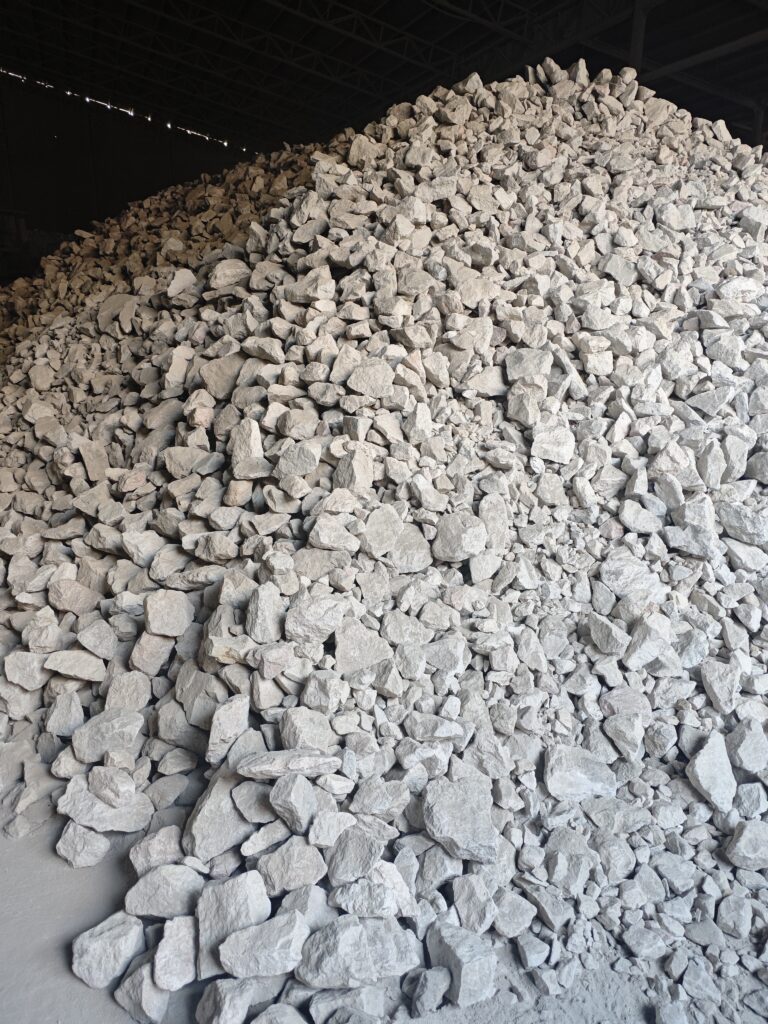
The DBM you buy might be in the form of coarse grains, fine powder or a specific size distribution depending on its intended use. Brick plants use graded DBM as the aggregate for magnesia carbon bricks. Gunning mixes use finer fractions. The selection affects your lining life directly.
Why Purity Is the First Thing to Check
The most important number on any dead burnt magnesite specification is the MgO content. High quality DBM has 96% to 98% MgO. Anything below 95% means more impurities and impurities are the enemy of refractoriness.
The main impurities are silica (SiO₂), iron oxide (Fe₂O₃) and calcium oxide (CaO). Silica is especially harmful because it forms low melting point phases with magnesia. At steelmaking temperatures, that glassy phase softens and allows slag penetration. The brick erodes faster.
Some suppliers offer DBM with 94% MgO at a lower price. It might look like a bargain, but the extra 2% to 3% of impurities can reduce lining life by 20% or more. Over a furnace campaign, that cost difference becomes very obvious.
So the first rule is simple: buy the highest MgO purity your budget allows. For high wear areas like the slag line, you should insist on 97% minimum. For less critical zones, 95% to 96% may be acceptable.
The Density Question
Purity tells you what is in the DBM. Density tells you how well it will perform. Higher density means lower porosity, which means better resistance to slag penetration.
The standard measure is bulk density, measured in grams per cubic centimeter. Good DBM has a bulk density of 3.2 to 3.4 g/cm³. If your supplier offers DBM with density below 3.1 g/cm³, the material is not fully dead burnt. It will continue to shrink and crack in service, which is a disaster for your lining.
There is a simple way to check this without a lab. Ask for the apparent porosity as well. Well burnt DBM has apparent porosity below 5%. If the porosity is over 8%, the material is underfired. Pass on it.
Another point to watch is the crushing strength of individual grains. Stronger grains hold up better against mechanical abrasion from scrap charging and slag flow. This is not always on the certificate, but a reputable supplier will provide it on request.
How Paticle Size Affects Your Lining
Dead burnt magnesite is sold in different size fractions. Choosing the right one is not trivial.
For brick manufacturing, a typical recipe uses a blend of coarse grains (2 to 5 mm) and fine powder (below 0.1 mm). The coarse grains provide the structure and dimensional stability. The fines fill the gaps and increase the packing density. A well balanced gradation gives strong, dense bricks.
For gunning mixes or patch materials, you generally want a finer product so it flows through the spray nozzle and adheres to the hot surface. Too coarse and the mix will bounce off the wall. Too fine and it will not build thickness.
When you order DBM, ask for the full particle size distribution, not just the nominal size. Some suppliers screen poorly, leaving too many fines or too many oversize grains. Either one will affect your processing.
Also, watch out for segregation. During shipping and handling, fine and coarse fractions can separate. When you take a sample for testing, take multiple samples from different bags or different parts of the container. One sample might not represent the whole shipment.
A Common Misconception about Dead Burnt Magnesite
Many buyers assume that all DBM is basically the same because the chemical formula is similar. That is not true.
Two lots of DBM with identical MgO content can behave very differently. The difference comes from the mineralogy of the original magnesite and the calcination conditions. Some DBM contains a higher proportion of large, well formed periclase crystals. Those large crystals are more resistant to slag corrosion than fine interlocking crystals.
The crystal size is not usually on the certificate. But you can see it under a microscope. More practically, you can test the material yourself. Take a sample of the DBM, make a small bricklet and expose it to a slag at high temperature. The one that corrodes slower is better.
Another often overlooked factor is the silica type. Some dead burnt magnesite has silica in the form of small inclusions that are fairly inert. Other dead burnt magnesite has silica as a continuous grain boundary phase that melts easily. The latter is bad news.
When you work with a supplier who understands metallurgy, they can tell you these details. A supplier who only talks about MgO percentage probably does not know the answer themselves.
What Causes DBM to Fail in Service
Even if you buy good dead burnt magnesite, it can still perform poorly if the bricks are not made correctly or if your furnace practice is aggressive. Here are the main failure modes.
Slag penetration is the most common cause. When liquid slag enters the pores of the brick, it dissolves the magnesia and carries it away. The brick thins. To resist this, you need DBM with low porosity and large periclase crystals. Also, adding carbon to the brick helps because carbon is not wet by slag.
Thermal spalling happens when the brick surface cools rapidly and cracks. DBM has high thermal expansion, which makes it prone to spalling. That is why magnesia carbon bricks use graphite to absorb the stress. Without carbon, DBM bricks will spall badly.
Hydration is a different problem. DBM itself does not hydrate easily, but fine dust from DBM can pick up moisture. In humid conditions, the magnesium oxide can turn into magnesium hydroxide, causing volume expansion and cracking of the brick. Store DBM in dry conditions and use it within a reasonable time.
How to Qualify a New Dead Burnt Magnesite Supplier
Changing DBM suppliers is risky. A bad batch can ruin a whole furnace campaign. But if you are not happy with your current source, here is a practical qualification process.
Start with a small trial order, say 20 to 30 tons, not a full container. Use this material in one section of your furnace or in one type of brick. Monitor the wear rate carefully. Compare it to your current DBM.
Check the chemistry and density against the certificate. If there is a discrepancy, send samples to an independent lab. A 1% difference in MgO might not seem like much, but it will show up in lining life.
Also look at the consistency from bag to bag. Take five random bags and sample each one. If the MgO varies by more than 0.5%, the supplier’s blending or sourcing is inconsistent. That is a red flag.
Finally, talk to the supplier about their quality control. Do they test every batch? What is their sampling procedure? Can they provide historical data? A serious supplier will answer these questions readily. A casual one will deflect.
At JINLI GROUP, we do not just hand you a bag of material and walk away. We help you evaluate the product, interpret the data and make an informed decision.
When to Accept Lower Grade DBM
There are situations where lower purity DBM is acceptable. If you are lining the upper sidewalls of an EAF where wear is low, 95% MgO DBM will work fine. It costs less and still gives good life in that zone.
The key is to match the grade to the duty. A single grade for the entire lining is rarely optimal. You are either overpaying in high wear zones or underperforming in low wear zones.
Some mills use a zoned lining approach: high grade (97‑98% MgO) at the slag line and the impact zone, medium grade (95‑96%) for the sidewalls and lower grade (92‑94%) for the bottom or for temporary patching. This is a smart way to manage cost without sacrificing performance.
Conclusion
Dead burnt magnesite is the foundation of your refractory performance. Purity, density, particle size and crystal structure all matter. A cheap material with 94% MgO will save you money on the invoice but cost you dearly in lining life and downtime.
Take the time to qualify your supplier. Test incoming material. Match the grade to the zone. And do not rely on the certificate alone.
If you need help evaluating your DBM supply or if you want a second opinion on a new source, reach out to JINLI GROUP. We have been working with steelmakers long enough to know what questions to ask and what answers to trust.
If you have any needs, please contact us without any hesitation!