Introduction
Most steelmakers today use cored wire for calcium treatment. It is clean, precise and easy to automate. But there is still a place for calcium silicon alloy in lump or granular form —— especially in smaller mills, foundries or situations where a wire feeder is not available.
The challenge with lump alloy is that calcium is volatile. Add it carelessly and half of it vaporizes before it ever touches the steel. Add it right and you get decent recovery at a lower cost than cored wire.
At JINLI GROUP, we supply calcium silicon alloy to customers who still prefer the traditional route. This article covers the practical side: what grade to buy, how to add it and how to get the most out of every kilogram.
What’s Calcium Silicon Alloy?
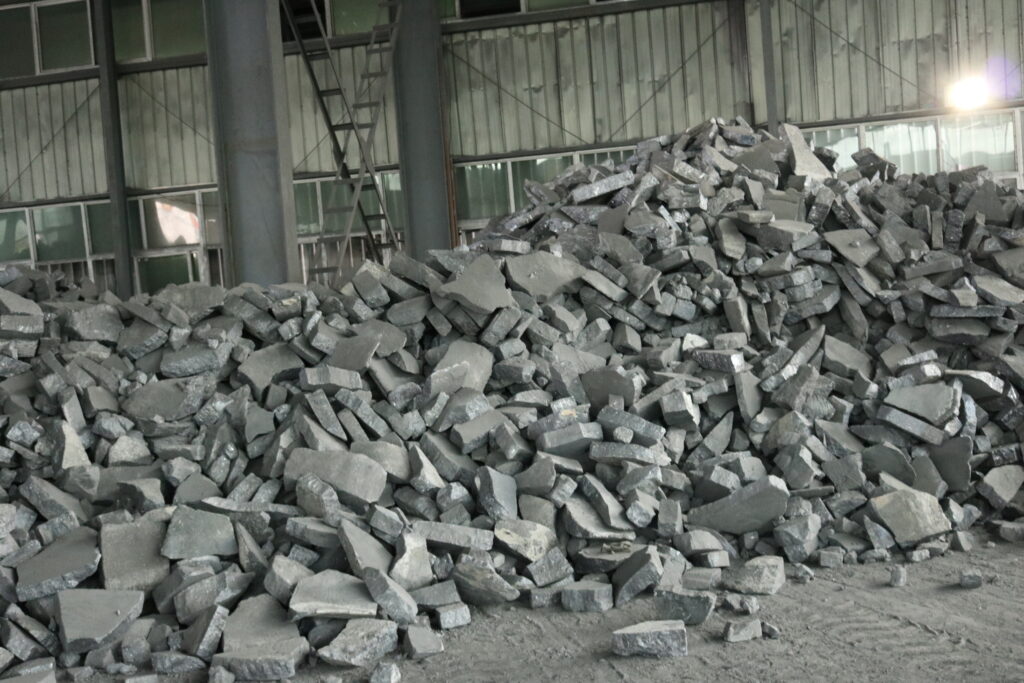
Calcium silicon alloy is a ferroalloy composed mainly of calcium and silicon, with typical calcium content of 28% to 31% and silicon 55% to 65%. The balance is iron, with small amounts of aluminum, carbon and phosphorus. It comes in irregular lumps ranging from a few millimeters to 50 mm or more, or in crushed granular form.
This alloy is used for the same purposes as calcium cored wire: deoxidation, desulfurization and inclusion modification. The difference is that the alloy is added directly to the ladle or furnace, without a steel sheath to protect it. That makes the addition technique critical.
When to Choose Calcium Silicon Alloy Over Cored Wire
Cored wire is convenient, but it is not always the best answer. Here are several situations where calcium silicon alloy still makes sense.
To begin with, when you do not have a wire feeder. Many smaller foundries and mini-mills operate without cored wire equipment. Installing a feeder costs money and takes space. If you only make a few heats per day, the investment may not be justified.
Secondly, when you need a larger, bulk addition of calcium. A single lump addition can deliver more total calcium than several meters of wire, which can be helpful for initial desulfurization before fine-tuning with wire later.
Another common scenario is in the electric arc furnace during the reduction period. Some operators add calcium silicon alloy to the furnace slag to help reduce oxides before tapping. This is a practice that has been around for decades and still works.
Cost is another factor. For ordinary steel grades that do not require tight calcium control, lump alloy is often cheaper on a per-kilogram basis than cored wire. If you can achieve acceptable recovery, the savings add up.
The Big Challenge: Calcium Loss
The reason cored wire exists is that pure calcium and high-calcium alloys are difficult to add. Calcium boils at 1484°C. Your molten steel is at 1550°C to 1650°C. If the alloy sits on the surface, the calcium will vaporize.
In a ladle, calcium silicon alloy lumps that are thrown on top of the slag will mostly react with the slag and the air. Recovery can be as low as 10% to 20%. The same alloy added properly can give 30% to 40% recovery. That gap is significant.
So the real question is not whether to use calcium silicon alloy, but how to add it so that the calcium reaches the steel.
How to Add Calcium Silicon Alloy for Better Recovery
Let me share a few methods that have worked for our customers.
Method one: deep addition during tapping. When the steel is being tapped from the EAF to the ladle, add the calcium silicon alloy into the ladle before the steel stream hits. The turbulence of tapping helps mix the alloy into the steel. This is the most effective way to get good recovery, often 35% to 45%. The key is to add it early in the tap, not at the end.
Method two: bagged addition. Place the calcium silicon alloy in a small steel or paper bag and attach it to a lance. Push the lance down into the ladle, then release the bag. The alloy is released below the slag surface, where the calcium can dissolve instead of vaporizing. This method is more work but gives recovery close to cored wire levels.
Method three: use a hopper and pipe. For granular material, blow the calcium silicon alloy through a pipe submerged in the ladle, using argon or nitrogen as a carrier gas. This is essentially the same principle as cored wire but with loose powder. Recovery is variable but usually better than surface addition.
A word of caution. Do not add calcium silicon alloy to a ladle with a thick, oxidizing slag. The slag will absorb the calcium before it reaches the steel. Keep the slag thin and basic. If you cannot reduce the slag thickness, use a longer lance to get below it.
The Importance of Particle Size
When you order calcium silicon alloy, you will be offered different size ranges. This choice affects how the alloy behaves.
Lump size (10-50 mm) is suitable for furnace additions or for dropping into the ladle during tapping. The larger pieces sink faster and dissolve more slowly, giving calcium time to react deeper in the bath. However, they dissolve slower and may not fully react before casting.
Granular size (1-10 mm) is used for injection or for addition through a pipe. The smaller particles dissolve quickly, but they also have more surface area that can oxidize. If the granules are too fine (below 1 mm), they may be lost to the slag or dust collection.
Mixed sizes are common but not ideal. If you have a wide distribution —— from dust to 50 mm lumps, you will get inconsistent recovery. The fines will dissolve or oxidize early, while the lumps may not finish dissolving. A narrow size range gives you a more predictable result.
For most ladle addition practices, a 5-20 mm or 10-30 mm range works well. If you are injecting, ask for 1-5 mm with minimal fines.
How to Judge Calcium Silicon Alloy Quality
Quality varies between suppliers. Here is what to look for when you receive a shipment.
Check the calcium content. The specification may say 30% calcium, but the actual content can vary. A good supplier holds it within ±1%. Take a sample from different bags and send it to your lab. If one bag is 28% and another is 32%, your addition will be inconsistent.
Look at the surface. Fresh calcium silicon alloy has a metallic gray appearance. If the pieces have a white or chalky coating, that means calcium oxide has formed, probably from moisture or poor storage. That oxidized layer is useless for your steel.
Check the dust content. Pour a bag of alloy through a sieve with 1 mm openings. If more than 5% passes through, there are too many fines. Those fines will oxidize quickly and reduce your effective calcium.
Ask about phosphorus and carbon. For most steel grades, these are not critical, but for specialty steels, high phosphorus can be a problem. Make sure the certificate shows low impurity levels.
At JINLI GROUP, we supply calcium silicon alloy with consistent chemistry and controlled sizing. Each batch is sampled and analyzed before shipment.
Storage and Handling
Calcium silicon alloy is less reactive than pure calcium, but it still needs care. Store in a dry warehouse, on pallets, off the floor. Do not leave bags exposed to rain or high humidity. The calcium component will absorb moisture and form calcium hydroxide, which not only reduces the effective calcium but also generates heat.
If a bag has been sitting in damp conditions, inspect the material before using. If it feels warm or has white dust, do not use it.
When You Still Need Cored Wire
Calcium silicon alloy is a good tool, but it has limits. For precision calcium treatment, especially for aluminum-killed steels where inclusion modification must be consistent, cored wire is still superior. The wire allows you to control the addition amount meter by meter and the steel sheath protects the calcium until it reaches depth.
Many mills use both: calcium silicon alloy for bulk desulfurization in the furnace or early ladle and cored wire for final trimming and inclusion control. This hybrid approach gives you the cost benefit of alloy and the precision of wire.
Why JINLI GROUP for Calcium Silicon Alloy
We have been in the ferroalloy business for years. Calcium silicon alloy is one of our standard products. We source from established producers, verify chemistry and size to your specification. Our packaging is usually 1 MT bags, it is designed for export and for easy handling on your shop floor.
We also understand that not every customer has the same practice. If you need a recommendation on size, packaging or addition method, talk to us. We will work with you.
Conclusion
Calcium silicon alloy is not obsolete. It remains a practical, cost-effective calcium source for mills without wire feeders, for bulk desulfurization and for certain furnace practices. The trick is to add it correctly, below the slag surface and with good mixing and to choose a product with consistent chemistry and sizing.
If you have been using alloy with poor recovery, review your addition method. Often a small change makes a big difference. And if you need a reliable supplier who cares about your results, contact JINLI GROUP. We will help you get the most out of your calcium silicon alloy.
If you have any needs, please contact us without any hesitation!