Introduction
Carbon adjustment seems simple. You need a certain carbon level in the steel, so you add a recarburizer. But not all carbon is the same. If you have ever seen carbon recovery bounce between 60% and 90% from one heat to the next, you know there is more to it.
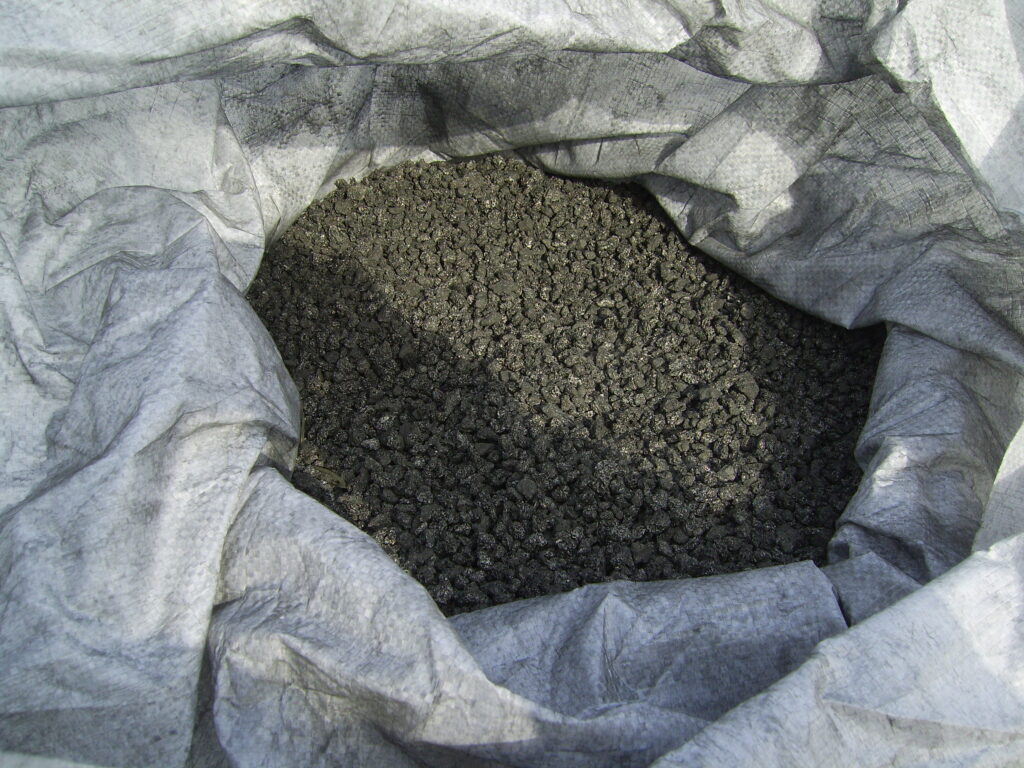
Calcined petroleum coke (CPC) is one of the most common recarburizers used in steelmaking. It is made from raw petroleum coke that has been heated to drive off volatile matter, leaving behind a dense, high-purity carbon material. When chosen and fed correctly, CPC gives you consistent carbon recovery without introducing unwanted impurities.
At JINLI GROUP, we supply CPC to steel mills and foundries around the world. This article is not a chemistry lecture. It is a practical guide on what to look for in a CPC product and how to use it without wasting carbon or damaging your steel.
The Two Main Grades: CPC and GPC
Before going further, let me clear up a common confusion. You will hear two terms: CPC (calcined petroleum coke) and GPC (graphitized petroleum coke). Both are used as recarburizers, but they are different.
CPC is calcined at around 1300°C. It has a crystalline structure but is not fully graphitized. GPC is heated above 2500°C, which aligns the carbon structure into graphite. GPC has lower sulfur and nitrogen and it dissolves faster. It is also more expensive.
For most carbon steel, low-alloy steel and even many specialty grades, CPC works perfectly well. The key is to match the grade to your steel’s impurity limits. If you need very low sulfur or nitrogen, you may need GPC. But for everyday production, CPC offers the best value.
What to Check on a CPC Specification Sheet
When a supplier sends you a CPC analysis, do not just look at the fixed carbon number. Here is what matters most.
Fixed carbon should be 98.5% or higher. Lower than that means more ash, which turns into slag and wastes your money.
Sulfur content is critical. For steels that require low sulfur, use CPC with less than 0.5% sulfur. Some CPC grades have sulfur as high as 3%, those are only suitable for cast iron or very dirty steel practices. Know your steel specification before ordering.
Nitrogen content matters for aluminum-killed steels that are sensitive to nitrogen embrittlement. High nitrogen CPC can cause pinholes and reduced ductility. If you make drawing quality or pipe grades, ask for CPC with nitrogen below 300 ppm.
Moisture seems minor, but wet CPC causes hydrogen pickup and poor recovery. Good CPC has less than 0.5% moisture. Store it in dry conditions.
Particle size affects dissolution rate and recovery. Fine particles dissolve quickly but can be lost to the slag or sucked into the dust collector. Coarse particles dissolve slowly and may not fully dissolve before casting. A well-graded CPC with a range of 1 to 5 mm is a good starting point.
How CPC Dissolves in Steel —— The Practical Side
Carbon dissolution is not instant. The CPC particles must be wetted by the steel, then the carbon diffuses into the melt. Several factors influence how fast and completely this happens.
Firstly, temperature. Hotter steel dissolves carbon faster. If you add CPC at 1550°C, it will take longer than at 1600°C. That means you need to add it early enough in the heat, not at the very end when the steel is already heading to the caster.
Secondly, stirring. Good argon stirring brings the CPC particles into contact with fresh steel. Without stirring, the carbon can float on the surface and react with slag instead of dissolving. Always add CPC under strong stirring.
Thirdly, particle size distribution. If the CPC contains too many fines (below 0.5 mm), those tiny particles will oxidize in the air or float on the slag. They never reach the steel. If the CPC has too many coarse lumps (above 8 mm), they may sink to the bottom and dissolve too slowly. A consistent size range gives the most reliable recovery.
Where to Add CPC
Different shops add CPC at different points. Each has its own advantages.
In the EAF during melting, CPC can be added with the scrap or through the roof. The high temperature and long residence time ensure complete dissolution. Recovery is typically 90% to 95%. However, some carbon will be lost to the slag and to oxidation from the oxygen lance. Also, adding too much CPC in the EAF can increase your slag volume.
In the ladle after tapping, CPC is added under argon stirring. This gives you precise control because you can adjust after knowing the tap carbon. Recovery is usually 70% to 85% depending on how well the ladle is stirred and the slag condition. The downside is that you have limited time before casting.
In the furnace after meltdown but before refining, many mills add a portion of CPC to make up the carbon target, then fine-tune in the ladle. This hybrid approach is common and works well.
Here is a tip. If you add CPC to the ladle, do not just dump it on top of the slag. Use a small pipe or a tube to inject the powder below the slag surface or mix the CPC with some steel scrap to help it sink. Otherwise, most of the carbon will float on the slag and slowly oxidize.
Why Recovery Varies and What to Do
Recovery means how much of the added carbon actually stays in the steel. If you add 100 kg of CPC with 98% fixed carbon, theoretically you add 98 kg of carbon. If the steel gains only 70 kg, recovery is about 71%.
Low recovery comes from several sources.
Oxidation is the biggest one. Carbon reacts with oxygen from the air, from the slag or from dissolved oxygen in the steel. That is why you should always add CPC after deoxidation? Actually no, carbon is itself a deoxidizer. But if you add CPC to steel with high oxygen activity, some carbon will burn away as CO gas. The solution is to add CPC early, before oxygen gets too high or to add it together with a deoxidizer like aluminum.
Slag absorption is another loss. If the slag is foamy or thick, CPC particles can get trapped and never reach the steel. Keep the slag thin and basic. If you have to add CPC into a deep slag, use a lance to inject it below the slag line.
Particle loss happens with very fine CPC. The fines can be pulled into the dust collection system or blown away by the argon bubbles. Using a product with controlled particle size helps.
A good target recovery for CPC added in the ladle is 80% to 85%. If you are consistently below 75%, check your addition method and your stirring practice.
A Common Mistake: Adding CPC Too Late
The worst time to add CPC is during the last five minutes before casting. The carbon does not have time to dissolve completely, especially if the CPC is coarse. You will end up with low recovery and potentially carbon-rich inclusions or even undissolved carbon particles in the final steel.
Add CPC at least 15 minutes before casting. If you use the ladle furnace, add it at the beginning of the LF cycle. If you use only the ladle after tapping, add it as soon as the ladle arrives at the stirring station.
How to Judge CPC Quality on Arrival
You do not always have time to send a sample to the lab. Here are a few quick checks you can do in your warehouse.
The moisture test. Take a handful of CPC and squeeze it. If your hand feels damp or if the CPC clumps together, the moisture is too high. Reject that shipment or dry it before use.
The ash test. Put a small sample of CPC on a white paper and shake it. If a lot of fine dust stays on the paper, the ash content may be high. Not a precise test, but a quick red flag.
The particle size check. Pour a bag of CPC through a set of sieves if you have them. At minimum, look at the proportion of fines (below 0.5 mm) and oversize (above 8 mm). More than 10% fines will hurt recovery. More than 5% oversize may cause dissolution problems.
The appearance. Good CPC is dark gray to black, with a shiny, crystalline surface. If it looks powdery, dull or has a lot of white ash, it may be low-grade material.
At JINLI GROUP, we supply CPC that meets consistent specifications. Each shipment comes with a certificate of analysis. We also encourage you to do your own incoming inspection.
Storage and Handling Tips
CPC does not react with air or moisture as aggressively as calcium, but it still needs care. Store bags on pallets, off the concrete floor and covered with a tarp. Do not store CPC near sources of ignition, carbon dust can be combustible in high concentrations.
If CPC gets wet, do not use it. Wet carbon will cause hydrogen in the steel, leading to pinholes and embrittlement. Drying it is possible but rarely practical. Better to reject wet material.
When to Choose GPC Instead of CPC
As mentioned earlier, GPC (graphitized petroleum coke) is sometimes a better choice. Here are the situations where you should consider upgrading.
Low nitrogen specification. If your final steel requires nitrogen below 50 ppm, GPC with nitrogen under 100 ppm is safer. CPC typically has 300 to 800 ppm nitrogen.
Very low sulfur. For sulfur below 0.005%, CPC with 0.3% sulfur may still add measurable sulfur. GPC can have sulfur as low as 0.03%.
Fast dissolution. GPC dissolves faster because the graphitic structure is more easily wetted by steel. If you have limited time, for example, in a caster with a short ladle treatment, GPC can help.
For most carbon steels, structural steels and even many pipe grades, CPC is perfectly acceptable and much cheaper. Do not pay for GPC unless you need it.
Why JINLI GROUP for Your CPC
We have been in the steelmaking consumables business for years. CPC is one of our main products. We source from reliable calcining plants, test every batch and package for export conditions.
Our team understands that carbon adjustment is not just about chemistry. It is about recovery, timing and consistency. We can help you set up a trial to compare our CPC against your current supplier. If we cannot improve your recovery or lower your cost, you should not buy from us.
Conclusion
Calcined petroleum coke (CPC) is a workhorse recarburizer. It does the job reliably and economically when you choose the right grade and add it correctly. Pay attention to sulfur, nitrogen, moisture and particle size. Add early, stir well and keep the slag from stealing your carbon.
If you are tired of inconsistent carbon recovery or uncertain quality from your current supplier, try JINLI GROUP.
Contact us today to discuss your carbon addition needs.
If you have any needs, please contact us without any hesitation!