Introduction
If you have ever fed pure calcium wire into a ladle, you know the show. A loud pop, a burst of white smoke, sometimes even a small flare. It looks powerful. But is it efficient? Not always. In many steelmaking situations, CaSi cored wire – calcium silicon – quietly does a better job with less drama and lower cost per effective calcium.
At JINLI GROUP, we have supplied both pure calcium wire and CaSi wire to steel mills for years. We have seen the numbers side by side. This article is not about textbook chemistry. It is about what actually works on the ladle floor and why CaSi cored wire often comes out ahead.
The Basic Problem with Pure Calcium Wire
Let me start with a fact that surprises many young metallurgists. Calcium has a boiling point of about 1484°C. Your molten steel is usually 1600°C or hotter. So when pure calcium wire enters the ladle, the calcium does not just melt, it vaporizes instantly.
A lot of that calcium vapor rises straight to the surface. Some burns in the air, producing that white smoke. Some reacts with the slag instead of the steel. By the time the reaction is over, you might have recovered only 10% to 20% of the calcium you paid for. The rest is gone.
Now, add silicon to the mix. CaSi cored wire typically contains 28% to 31% calcium and 55% to 65% silicon. The silicon does two useful things. Firstly, it forms a more stable alloy. The vapor pressure of calcium in CaSi is much lower than in pure metal. That means the calcium is released more slowly and steadily, not in an explosive burst. Secondly, silicon itself is a good deoxidizer. It helps clean the steel while the calcium works on inclusion modification.
The result is often a higher effective calcium recovery from CaSi wire than from pure calcium wire, even though the CaSi wire has less calcium per meter.
Where CaSi Cored Wire Really Shines
Based on what we see in our customers’ mills, there are several types of steel where CaSi cored wire is not just an alternative, it is the preferred choice.
For aluminum-killed steels, the main job of calcium is to modify alumina inclusions into liquid calcium aluminates. This prevents nozzle clogging. CaSi wire does this job excellently. The silicon helps deoxidize any remaining oxygen, so the calcium can focus on the inclusions. Many mills that switched from pure calcium to CaSi actually saw fewer clogging incidents, not more.
For medium sulfur grades where you need some desulfurization but not extreme levels, CaSi wire gives a controlled reaction. The calcium is not wasted in violent vaporization. You can predict your sulfur removal much more reliably.
For long casting sequences, consistency is everything. Pure calcium wire can vary in recovery depending on steel temperature, slag thickness and even the humidity in the air. CaSi wire is much more forgiving. The recovery stays stable heat after heat, which keeps your nozzle life predictable.
Another situation is when your ladle slag is not perfectly basic or when you have some FeO in the slag. Pure calcium will react aggressively with the slag. CaSi wire is more tolerant because the silicon helps protect the calcium.
What About Cost
This is where people often get confused. Per kilogram, pure calcium wire is much more expensive than CaSi cored wire. But that is the wrong comparison. You need to compare cost per unit of effective calcium delivered.
Let me give you a rough example. Suppose pure calcium wire costs three times as much per meter as a CaSi wire with 30% calcium. But if your recovery from pure calcium is only 15%, while recovery from CaSi is 25%, the math changes. You actually get more usable calcium from the CaSi wire for the same money. Many mills have run this calculation and found that CaSi wire is the more economical choice for their regular steel grades.
There is also the cost of downtime. If pure calcium wire causes spattering that damages your ladle cover or your wire feeder or if inconsistent recovery leads to a clogged nozzle and a cast break, those costs dwarf the price difference of the wire. CaSi wire, being calmer and more predictable, helps avoid those hidden expenses.
How to Feed CaSi Cored Wire for Best Results
A few practical tips have come up again and again from experienced operators.
First of all, do not feed CaSi wire at the same speed as pure calcium wire. Because CaSi wire is denser and melts more slowly, you can often feed it a bit faster —— say 3 to 5 meters per second instead of 2 to 4 m/s. The exact speed depends on your ladle size and steel temperature. The sign you are doing it right: you see a steady but moderate bubbling at the surface, not explosive popping.
In addition, add CaSi wire after aluminum deoxidation, but before your final adjustments. The typical sequence is: add aluminum to kill the steel, then add CaSi wire for inclusion modification and desulfurization, then trim with other alloys. Do not add CaSi wire too early or the calcium will react with free oxygen and be wasted.
What’s more, aim for depth. The wire tip should reach at least 2 meters below the slag surface. If your wire feeder has an adjustable guide tube, set it so the wire enters vertically. Shallow feeding is the number one cause of poor recovery.
Another thing that works well: if you are currently using a blend of pure calcium and CaSi wire, try using only CaSi for a few heats. You might be surprised that you do not need the pure wire at all.
Signs Your CaSi Wire is Good Quality
Not all CaSi cored wire is the same. JINLI GROUP has seen cheap imports that cause more problems than they solve. Here is what to look for.
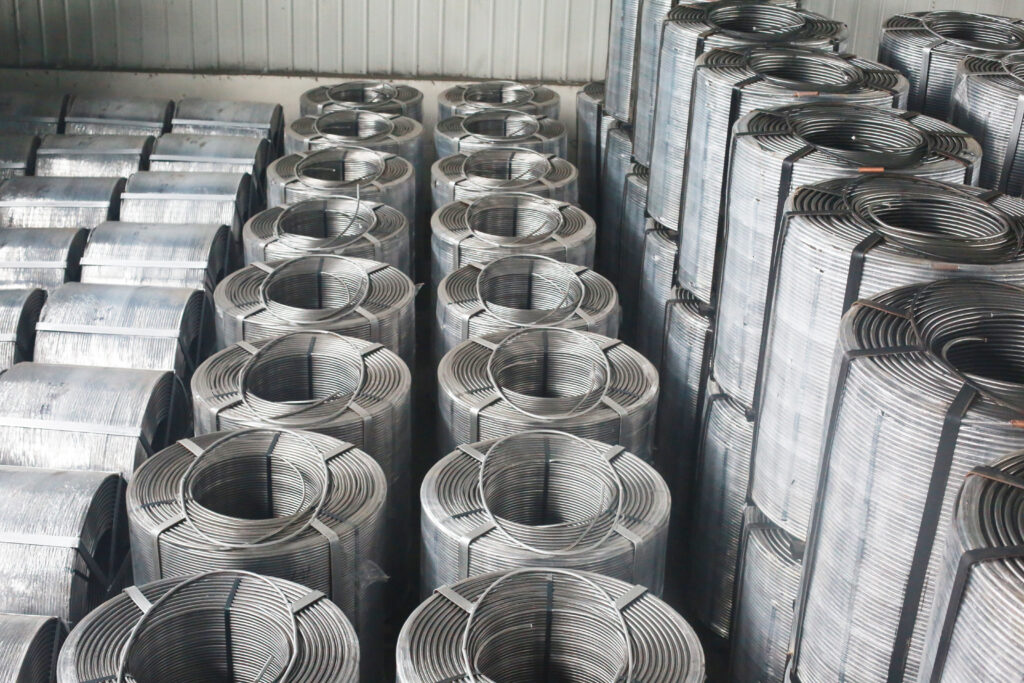
The core density should be uniform. If you cut a meter of wire and weigh the core, it should not vary more than 5% from one meter to the next. Uneven filling leads to uneven calcium addition.
The steel strip thickness matters. Too thin and the wire might break during feeding. Too thick and it may not melt deep enough. For most ladles, a strip thickness of 0.4 to 0.5 mm works well.
The seam weld should be strong and smooth. If you see gaps or rough edges, the wire can leak powder or break inside the guide tube.
And finally, the spooling must be even. A poorly wound spool will cause the wire to kink or snag, stopping your feeder in the middle of a heat. That is a headache you do not need.
At JINLI GROUP, we check all these points before shipping. Our CaSi cored wire is made to consistent standards and we stand behind it.
When Should You Still Use Pure Calcium Wire
I do not want to leave you with the idea that CaSi wire is always better. There are cases where pure calcium is still the right tool.
For very low sulfur steels (below 0.003% S) or for grades that require extremely clean inclusion populations, some bearing steels, for example, the stronger, faster calcium release from pure wire may be necessary. Also, if your steel has very low silicon specification and you cannot afford the extra silicon from CaSi, you have to use pure calcium.
But for the vast majority of carbon steels, construction steels, pipe steels and many aluminum-killed grades, CaSi cored wire gives you better value, better consistency and fewer surprises.
Why JINLI GROUP Recommends CaSi for Most Mills
We at JINLI GROUP do not push one product over another for the sake of it. But when we look at the data from our customers, the story is clear. Mills that switched to CaSi cored wire for their ordinary grades reported fewer nozzle clogs, lower calcium treatment cost per ton and more stable casting speeds.
We also offer CaSi wire with different calcium/silicon ratios, different diameters and different strip thicknesses. If you have a particular ladle size or a tricky grade, talk to us. We can recommend a specification and even help you run a trial.
Our export packaging keeps the wire dry and clean. We deliver to ports worldwide and we provide technical support remotely or on site if needed.
Conclusion
CaSi cored wire is not a new product. It has been around for decades. But many steelmakers still reach for pure calcium wire out of habit, missing the chance to improve both performance and cost. The calmer reaction, better recovery and greater consistency of CaSi wire make it the smarter choice for a wide range of steel grades.
If you are tired of white smoke, inconsistent nozzle life and unpredictable calcium recovery, give CaSi a try. JINLI GROUP is ready to supply you with high quality CaSi cored wire and the technical support to use it well.
Contact us to discuss your specific needs or to request a quote.
If you have any needs, please contact us without any hesitation!